
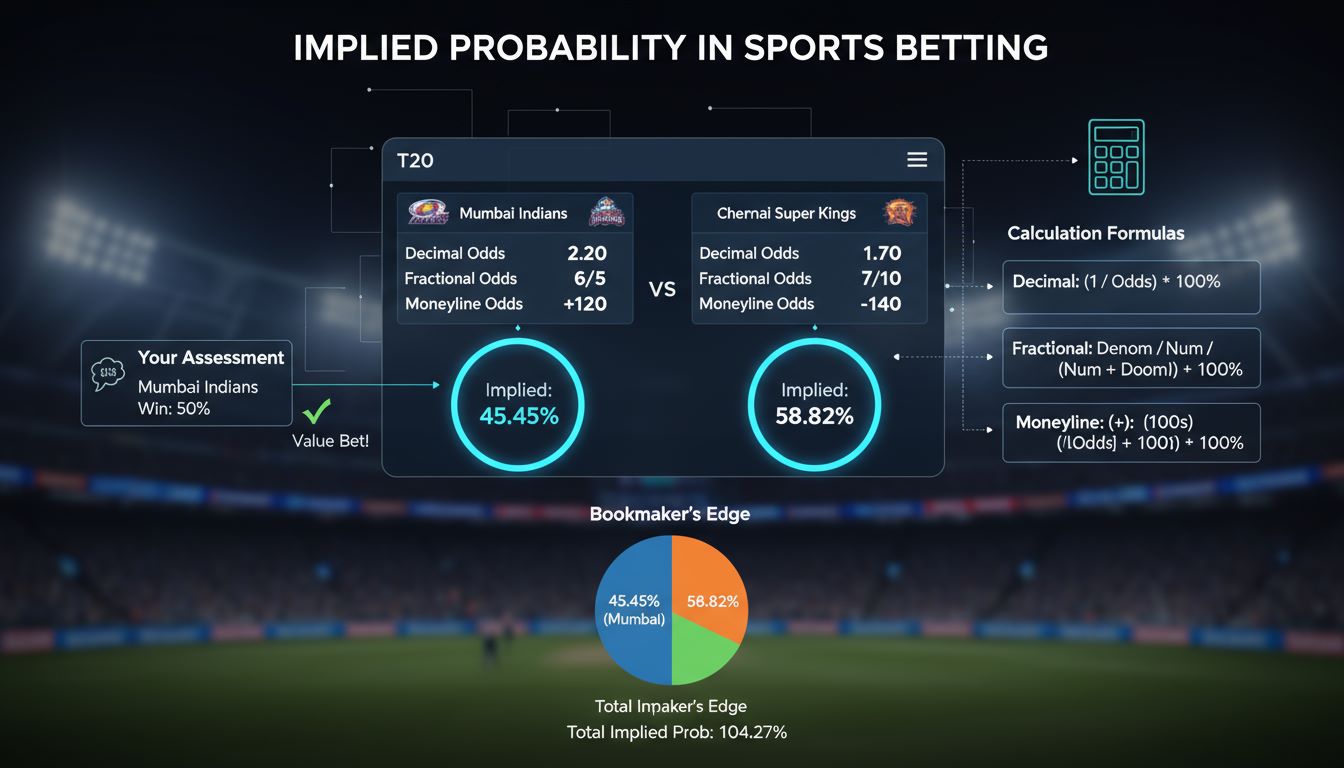
Understanding implied probability is crucial for making informed betting decisions in the rapidly growing Indian sports betting market. This mathematical concept allows bettors to convert odds into percentage probabilities, revealing the bookmaker’s assessment of an outcome’s likelihood and helping identify potential value opportunities.
Converting odds to implied probability serves as a fundamental tool for evaluating whether a bet offers genuine value compared to your own assessment of an event’s chances. By mastering this skill, Indian bettors can better understand bookmaker margins and make more strategic decisions across popular sports like cricket, football, and kabaddi.
Implied Probability and Its Significance in Indian Betting
Implied probability represents the likelihood of an outcome as suggested by betting odds, expressed as a percentage. For Indian bettors navigating diverse sports markets, this concept serves as the foundation for value assessment and strategic decision-making. When bookmakers set odds for IPL matches or football tournaments, they’re essentially communicating their calculated probability of each outcome occurring.
The significance of implied probability in Indian markets extends beyond simple odds conversion. It reveals the bookmaker’s profit margin, helps identify discrepancies between market perception and actual likelihood, and enables bettors to compare odds across different platforms popular in India. Understanding this concept transforms betting from guesswork into informed analysis.
Indian betting markets often feature unique characteristics, including varying odds formats and sport-specific margins. Cricket betting, particularly during IPL season, may show different implied probability patterns compared to football or kabaddi markets. These variations reflect factors like market liquidity, public betting preferences, and the bookmaker’s confidence in their pricing models.
Mastering implied probability calculation empowers Indian bettors to evaluate whether the odds offered truly reflect the fair probability of an outcome. This knowledge becomes particularly valuable when betting on familiar domestic competitions where personal expertise might reveal value opportunities that bookmakers have missed or mispriced.
The Role of Implied Probability in Evaluating Value Bets
Value betting relies heavily on implied probability calculations to identify opportunities where bookmaker odds don’t accurately reflect true probabilities. Indian bettors can leverage this approach across multiple sports and betting markets to improve their long-term profitability.
The practical applications of implied probability in value assessment include:
- Comparing bookmaker odds with your calculated fair probability to identify positive expected value bets
- Evaluating whether live betting odds during IPL matches offer better value than pre-match prices
- Assessing arbitrage opportunities between different Indian-friendly betting platforms
- Determining optimal stake sizing based on the perceived edge over bookmaker pricing
- Identifying markets where public bias may have inflated or deflated true probabilities
For example, if you believe Mumbai Indians have a 65% chance of winning an IPL match, but the bookmaker’s odds imply only a 55% probability, this represents a potential value betting opportunity. The gap between your assessment and the implied probability suggests the odds may be mispriced in your favor.
Impact of Bookmaker Margin on Indian Odds
Bookmaker margin, also known as the overround or vig, significantly impacts implied probability calculations for Indian bettors. This built-in profit margin means that when you add up the implied probabilities for all possible outcomes in a market, the total exceeds 100%. Understanding this concept is essential for accurate value assessment in Indian betting markets.
In Indian sports betting, margins typically range from 3-8% for major cricket matches and 5-12% for football games, depending on the platform and market popularity. These margins directly affect the implied probabilities you calculate, making it crucial to account for this skew when evaluating potential value bets and comparing odds across different bookmakers.
Core Formulas for Calculating Implied Probability
Mastering implied probability calculation requires understanding the specific formulas for different odds formats commonly used in Indian betting markets. Each format – decimal, fractional, and American odds – has its own conversion method, though decimal odds remain most popular among Indian platforms.
The accuracy of your implied probability calculations directly impacts your ability to identify value bets and make profitable decisions. These formulas serve as your mathematical foundation for converting any odds format into meaningful probability percentages that you can compare against your own assessments.
| Odds Type | Formula | Example Calculation | Explanation |
|---|---|---|---|
| Decimal Odds | 1 ÷ Decimal Odds × 100 | 1 ÷ 2.50 × 100 = 40% | Most common format in Indian platforms |
| Fractional Odds | Denominator ÷ (Numerator + Denominator) × 100 | 2 ÷ (3 + 2) × 100 = 40% | Traditional format, less common in India |
| American Odds (Positive) | 100 ÷ (American Odds + 100) × 100 | 100 ÷ (150 + 100) × 100 = 40% | For underdogs, rarely used in India |
| American Odds (Negative) | (-American Odds) ÷ ((-American Odds) + 100) × 100 | 150 ÷ (150 + 100) × 100 = 60% | For favorites, minimal usage in Indian markets |
These formulas provide the mathematical foundation for converting any odds format into implied probability percentages. While decimal odds dominate Indian betting platforms, understanding all formats ensures you can accurately assess value regardless of how odds are presented.
The consistency across these formulas means that equivalent odds in different formats will always produce identical implied probabilities. For instance, decimal odds of 2.50, fractional odds of 3/2, and American odds of +150 all represent the same 40% implied probability, demonstrating the mathematical relationship between these formats.
Application of Implied Probability Formulas in India
Indian betting platforms predominantly use decimal odds, making the basic division formula your most frequently applied tool. When betting on IPL cricket matches, Premier League football, or Pro Kabaddi League games, you’ll typically encounter decimal odds ranging from 1.01 for heavy favorites to 50.00 or higher for extreme longshots.
The practical application involves quick mental calculations during live betting scenarios. For example, if Chennai Super Kings’ odds move from 1.80 to 2.00 during an IPL match, you can instantly recognize that the implied probability dropped from 55.6% to 50%, suggesting a significant shift in market sentiment that might create value opportunities.
Understanding these formulas becomes particularly valuable when comparing odds across multiple Indian-friendly platforms. Different bookmakers may display slightly different decimal odds for the same outcome, and calculating implied probabilities helps identify which platform offers the most favorable pricing for your intended bet.
Step-by-Step: Calculating Implied Probability for Common Indian Odds Formats
Converting odds to implied probability becomes straightforward when following a systematic approach. These step-by-step instructions cover the most common scenarios Indian bettors encounter, from simple match winners to complex proposition bets across cricket, football, and kabaddi markets.
The process remains consistent regardless of the specific sport or betting market, though some nuances apply when dealing with Asian handicaps or over/under totals popular in Indian football betting. Mastering these steps enables quick probability assessment during both pre-match analysis and live betting situations.
- Identify the odds format displayed on your chosen Indian betting platform (typically decimal odds)
- Apply the appropriate formula: for decimal odds, divide 1 by the odds value
- Multiply the result by 100 to convert from decimal to percentage format
- Round to one or two decimal places for practical use in betting decisions
- Compare the calculated implied probability with your own assessment of the outcome’s likelihood
- Account for bookmaker margin by calculating the overround across all possible outcomes
- Determine if the odds represent value based on the probability gap and margin analysis
This systematic approach ensures accuracy and consistency in your probability calculations, reducing errors that could lead to poor betting decisions. Regular practice with these steps develops the mental agility needed for quick calculations during live betting scenarios common in Indian cricket and football markets.
Practical Examples: IPL Betting and Implied Probability
The Indian Premier League provides excellent examples for understanding implied probability calculations in practice. IPL betting markets offer diverse opportunities, from match winners and top batsmen to specific over outcomes and player performance props.
Consider a typical IPL match where Royal Challengers Bangalore faces Kolkata Knight Riders. The decimal odds and corresponding implied probabilities might look like the following examples, demonstrating how bookmakers assess each team’s chances based on current form, pitch conditions, and team composition.
| Betting Market | Odds | Implied Probability (%) |
|---|---|---|
| RCB Match Winner | 1.85 | 54.05% |
| KKR Match Winner | 2.10 | 47.62% |
| Virat Kohli Top RCB Batsman | 3.25 | 30.77% |
These examples demonstrate how implied probability reveals bookmaker sentiment about different outcomes. Notice that the match winner probabilities add up to 101.67%, indicating a 1.67% bookmaker margin built into the pricing.
The player prop bet shows how individual performance markets typically carry higher margins, as evidenced by wider probability spreads. Understanding these patterns helps Indian bettors identify where bookmakers may be most vulnerable to value betting opportunities.
When analyzing IPL betting markets, pay attention to how implied probabilities shift based on team news, weather conditions, and pitch reports. These factors significantly influence cricket outcomes, and sharp movements in implied probability often signal important information becoming available to the betting market.
Common Mistakes When Calculating Implied Probability
Even experienced bettors make calculation errors that can lead to poor decision-making and missed value opportunities. Understanding these common pitfalls helps Indian bettors maintain accuracy when converting odds and assessing betting markets across cricket, football, and other popular sports.
Recognition and avoidance of these errors becomes particularly important during live betting scenarios where quick calculations are necessary, and mathematical mistakes can prove costly. The following mistakes represent the most frequent issues encountered by Indian bettors:
- Confusing odds formats and applying the wrong conversion formula, especially when switching between platforms
- Forgetting to account for bookmaker margin when comparing implied probabilities across different outcomes
- Rounding calculations too aggressively, leading to cumulative errors in value assessment
- Misunderstanding negative American odds calculations when encountering international betting platforms
- Failing to recalculate implied probabilities when odds change during live betting sessions
These calculation errors can compound over time, leading to systematic misjudgments about value betting opportunities. Developing consistent calculation habits and double-checking important computations helps maintain accuracy in your betting analysis.
The most costly mistakes typically occur when bettors assume they’ve found significant value without properly accounting for bookmaker margins or when they misapply formulas during high-pressure live betting situations common in IPL cricket matches.
Using Implied Probability to Identify Value Bets in India
Value betting represents the cornerstone of profitable sports betting, and implied probability serves as your primary tool for identifying these opportunities in Indian markets. By comparing bookmaker-implied probabilities with your own calculated assessments, you can spot situations where odds don’t accurately reflect true likelihood of outcomes.
The following scenarios illustrate how implied probability analysis reveals value betting opportunities across popular Indian sports markets. Each example demonstrates the decision-making process when your probability assessment differs from bookmaker pricing.
| Scenario | Odds | Implied Probability | Actual Probability (User Assessment) | Value Indicator |
|---|---|---|---|---|
| Mumbai Indians vs CSK Winner | 2.20 | 45.45% | 52% | Positive Value |
| Over 2.5 Goals – Man City Match | 1.75 | 57.14% | 62% | Positive Value |
| Bengaluru FC Asian Handicap +0.5 | 1.90 | 52.63% | 48% | Negative Value |
| Pro Kabaddi Total Points Over 65 | 2.10 | 47.62% | 55% | Strong Positive Value |
| KL Rahul 50+ Runs in ODI | 3.00 | 33.33% | 40% | Moderate Positive Value |
These examples demonstrate how probability gaps indicate potential value opportunities across different Indian sports markets. The key lies in developing accurate probability assessment skills through research, statistical analysis, and understanding of sport-specific factors that bookmakers might overlook or misprice.
Identifying ‘Market Edge’ Using Probability Gaps
Market edge emerges when your calculated probability significantly differs from the bookmaker’s implied probability, creating potential profit opportunities for informed bettors. In Indian betting markets, these gaps often appear due to public bias toward popular teams, incomplete information about player conditions, or bookmaker conservatism in less liquid markets.
The magnitude of probability gaps determines the strength of potential value bets. A 5-7% gap might represent moderate value worth considering, while gaps exceeding 10% could indicate strong betting opportunities or potential errors in your analysis. Context matters significantly – a 5% edge in a liquid IPL match carries different implications than the same gap in a domestic kabaddi fixture.
Successful market edge identification requires combining implied probability analysis with deep knowledge of specific sports and competitions popular in India. Understanding factors like pitch conditions in cricket, weather impact on football matches, or team chemistry in kabaddi helps develop more accurate probability assessments than bookmaker algorithms might produce.
Risks in Relying Solely on Implied Probability
While implied probability analysis provides valuable insights for Indian bettors, overreliance on this single metric can lead to incomplete risk assessment and poor betting decisions. Understanding these limitations helps maintain a balanced approach to value betting and market analysis.
- Ignoring external factors like team news, weather conditions, or venue-specific advantages that significantly impact outcomes
- Failing to account for odds movement and market sentiment shifts that may invalidate initial probability assessments
- Overlooking the impact of betting volume and liquidity on odds accuracy, particularly in smaller Indian sports markets
- Underestimating bookmaker sophistication and the possibility that apparent value bets reflect information asymmetry
- Neglecting bankroll management principles when probability calculations suggest strong value opportunities
The most successful Indian bettors use implied probability as one component of comprehensive betting analysis rather than the sole decision-making factor. Combining probability calculations with situational analysis, form study, and market timing creates more robust betting strategies than mathematical analysis alone.
Implied Probability in Indian Betting Markets: Cricket, Football, Kabaddi
Each major sport in Indian betting markets presents unique characteristics that influence how implied probability should be interpreted and applied. Cricket betting, dominated by IPL and international matches, features complex markets with multiple outcomes and extensive in-play betting options that create diverse probability scenarios throughout matches.
Football betting in India encompasses both international leagues like the Premier League and domestic competitions such as the Indian Super League. The probability calculations remain consistent, but market dynamics differ significantly between these competitions, with international matches typically offering more efficient pricing due to higher betting volumes and global interest.
Kabaddi represents a uniquely Indian betting market where local knowledge and cultural understanding provide significant advantages over international bookmakers. Pro Kabaddi League matches often feature wider betting margins and less efficient probability pricing, creating more frequent value betting opportunities for informed local bettors who understand team dynamics and player form patterns.
The application of implied probability across these sports requires adapting your analysis approach to each sport’s specific characteristics. Cricket’s stop-start nature creates numerous micro-betting opportunities, football’s continuous play generates different probability patterns, and kabaddi’s unique scoring system produces distinct value betting scenarios.
Understanding these sport-specific nuances enhances your ability to identify mispriced odds and probability discrepancies that might not be apparent to bettors focusing solely on mathematical analysis without considering the underlying game dynamics and market characteristics that influence bookmaker pricing strategies.
Why Implied Probability Differs Across Indian Sports
The variation in implied probability applications across different Indian sports reflects the unique characteristics of each betting market, from liquidity levels and public interest to the complexity of outcomes and availability of statistical data for bookmaker pricing models.
| Sport | Typical Odds Format | Implied Probability Use Case | Margin Impact |
|---|---|---|---|
| Cricket (IPL) | Decimal | Match winners, player props, live betting | Low (3-6%) |
| Football (ISL) | Decimal | Match results, Asian handicaps, totals | Medium (5-8%) |
| Kabaddi (PKL) | Decimal | Match winners, point spreads, totals | High (8-12%) |
| International Football | Decimal | All major markets, extensive props | Low (3-5%) |
These differences in margin impact and market efficiency create varying opportunities for value betting across different sports. Cricket and international football markets typically offer the most efficient pricing, while kabaddi and domestic football present higher margins but potentially more frequent mispricings that informed bettors can exploit.
The relationship between market liquidity and implied probability accuracy becomes particularly evident when comparing IPL cricket betting with Pro Kabaddi League markets. Higher betting volumes in cricket lead to more efficient probability pricing, while kabaddi’s smaller market size can result in slower odds adjustments and greater opportunity for identifying value bets through careful probability analysis.
Tools and Calculator Recommendations for Indian Bettors
Modern betting success requires efficient tools for calculating implied probability, especially when analyzing multiple markets simultaneously or during fast-paced live betting scenarios common in IPL cricket matches. The right calculator tools streamline your analysis process and reduce calculation errors that could compromise betting decisions.
Several categories of tools serve different needs for Indian bettors, from simple mobile apps for quick decimal odds conversion to comprehensive desktop software that handles complex probability analysis across multiple sports and betting formats simultaneously.
Key features to consider when selecting implied probability tools for Indian betting markets:
- Support for decimal odds format predominantly used by Indian-friendly betting platforms
- Real-time calculation capabilities for live betting scenarios during IPL and football matches
- Margin calculation features to assess bookmaker overround across different outcomes
- Multi-market comparison tools for evaluating odds across various Indian betting sites
- Mobile compatibility for on-the-go calculations during live sporting events
- Value betting identification features that highlight probability discrepancies automatically
- Historical odds tracking to analyze probability movements over time in specific markets
The most effective tools combine ease of use with comprehensive functionality, allowing quick probability calculations without sacrificing accuracy or analytical depth. Priority should be given to tools that handle the specific requirements of Indian betting markets and the sports most popular among local bettors.
Selecting the Right Betting Calculator for Your Market
Choosing appropriate calculation tools depends on your specific betting approach, preferred sports, and the complexity of markets you typically analyze. Indian bettors focusing primarily on IPL cricket might prioritize different features compared to those betting across multiple sports including kabaddi and football.
Consider your typical betting workflow when evaluating calculator options. If you frequently bet live during cricket matches, mobile-optimized tools with fast calculation speeds become essential. Conversely, if you prefer detailed pre-match analysis across multiple bookmakers, desktop tools with comprehensive comparison features might better suit your needs.
The integration capabilities of betting calculators also influence their practical value for Indian markets. Tools that can import odds from popular Indian betting platforms or integrate with odds comparison services streamline the analysis process and help identify the best available prices across different bookmakers for your calculated value bets.